
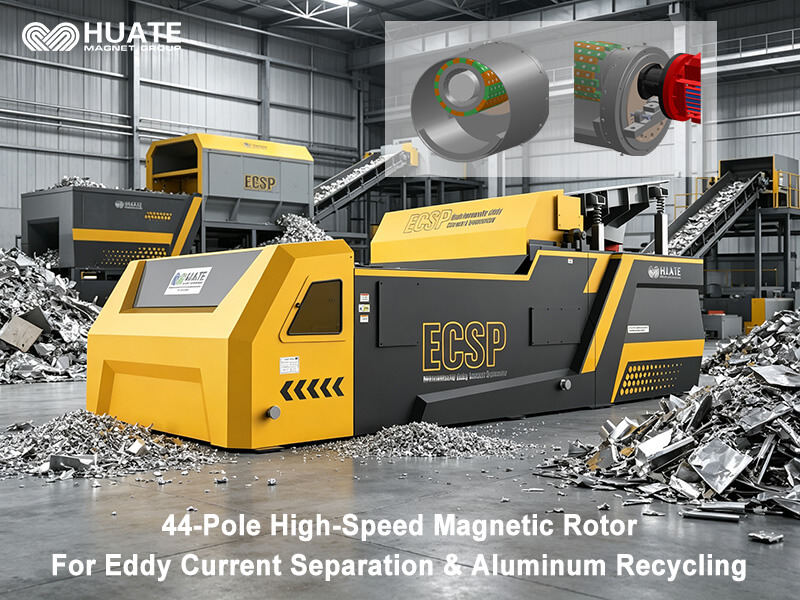
As the recycled aluminum industry continues to develop, increasingly complex scrap streams are placing higher demands on sorting efficiency, fine-particle recovery and high-speed operating stability. Mixed shredded aluminum often contains a wide range of particle sizes and non-ferrous metal components, making efficient separation a key challenge for modern recycling lines.
To address these challenges, Shandong Huate Magnet Technology Co., Ltd. (Huate) has developed a new 44-pole high-speed magnetic rotor for eddy current separation. The new rotor is designed to increase the frequency of alternating magnetic fields, improve the separation of fine non-ferrous metals and provide a more stable operating solution for scrap aluminum recycling systems.
Challenges of Conventional Eddy Current Magnetic Rotors
An eddy current separator uses a rapidly rotating magnetic rotor to generate a changing magnetic field. When conductive non-ferrous metals such as aluminum and copper pass through the magnetic field, eddy currents are induced inside the particles. The resulting repulsive force changes their trajectory, allowing non-ferrous metals to be separated from non-conductive materials.
This principle is widely used in ferrous and non ferrous metal recovery equipment and applications.
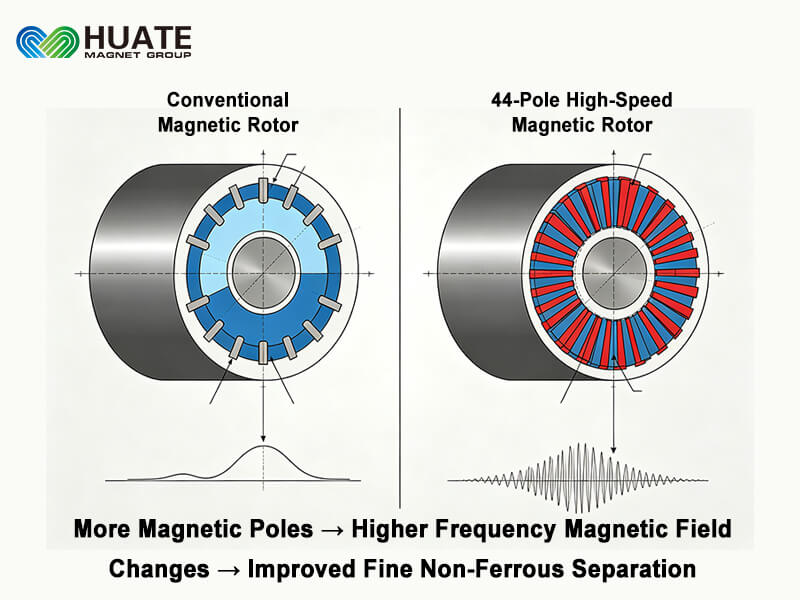
However, conventional magnetic rotors with relatively low pole numbers may produce fewer magnetic field changes during rotation. To obtain sufficient separation force, higher rotor speeds may be required. For mixed scrap streams containing fine aluminum and other non-ferrous particles, this can create challenges involving separation efficiency, vibration, component wear and fine-particle recovery.
For aluminum recycling plants processing complex and continuously changing feed materials, improving the magnetic rotor itself can therefore provide an important pathway to further optimize eddy current separation performance.
44-Pole Magnetic Rotor for High-Frequency Eddy Current Separation
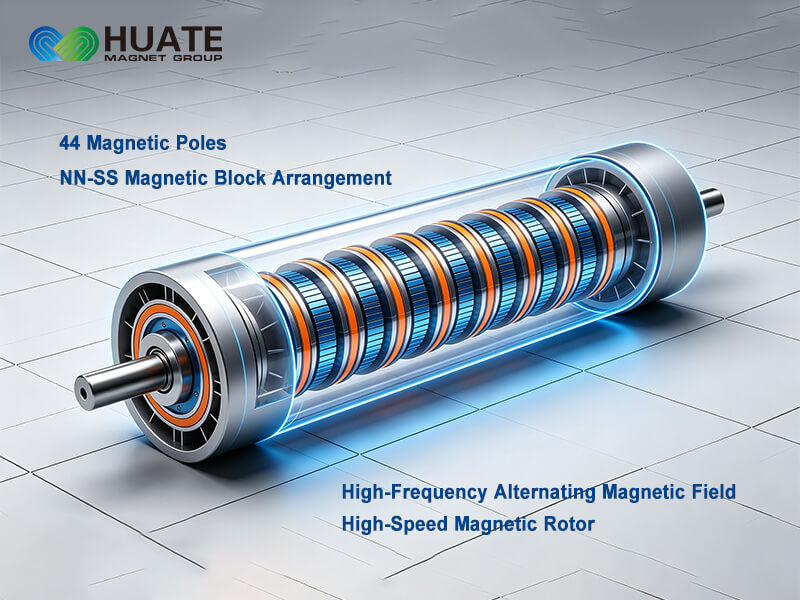
Huate’s newly developed 44-pole high-speed magnetic rotor adopts a dense two-row NN-SS magnetic block arrangement.
Compared with conventional rotor configurations, the increased number of magnetic poles creates more frequent magnetic field changes within the same rotational cycle. This increases the density of alternating magnetic fields and creates a smoother magnetic field transition.
The multi-pole magnetic configuration is designed to provide:
· Higher frequency magnetic field changes
· More uniform magnetic field distribution
· Improved induction of eddy currents in conductive particles
· Enhanced separation of fine non-ferrous metals
· Reduced dependence on extremely high rotor speeds
· More stable operation during continuous recycling processes
High-frequency rotor configurations are particularly relevant to fine non-ferrous metal recovery. Industry equipment suppliers also use higher pole counts and high-frequency magnetic rotors to improve the recovery of fine aluminum,copper,and other conductive materials.
Adjustable Eccentric Position for Flexible Separation Control
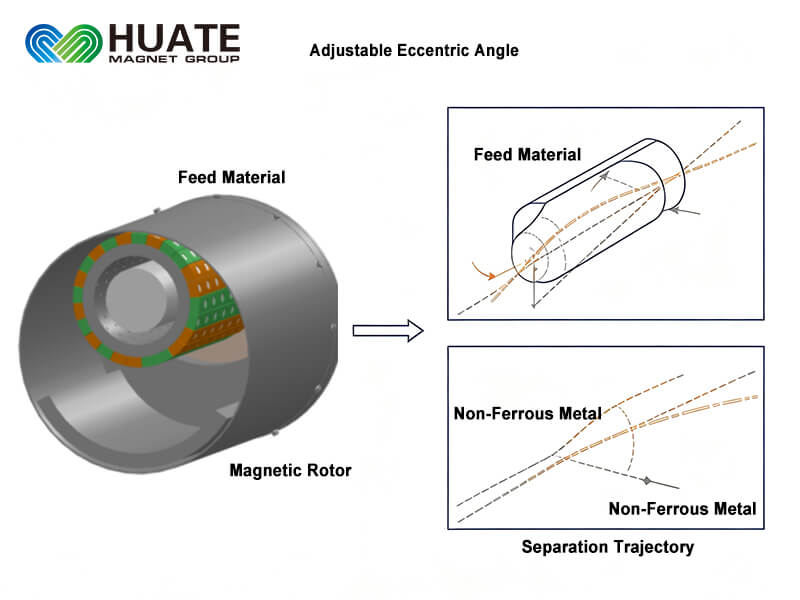
In addition to the multi-pole magnetic configuration, the rotor is equipped with an adjustable eccentric-angle structure.
The separation position can be adjusted according to feed particle size, material,composition,and operating conditions. By optimizing the interaction angle between the material flow and the magnetic field, the trajectory of repelled non-ferrous particles can be adjusted to improve separation quality.
This adjustable design provides greater flexibility when processing different scrap aluminum feed streams and can help operators optimize the separation point for specific material characteristics.
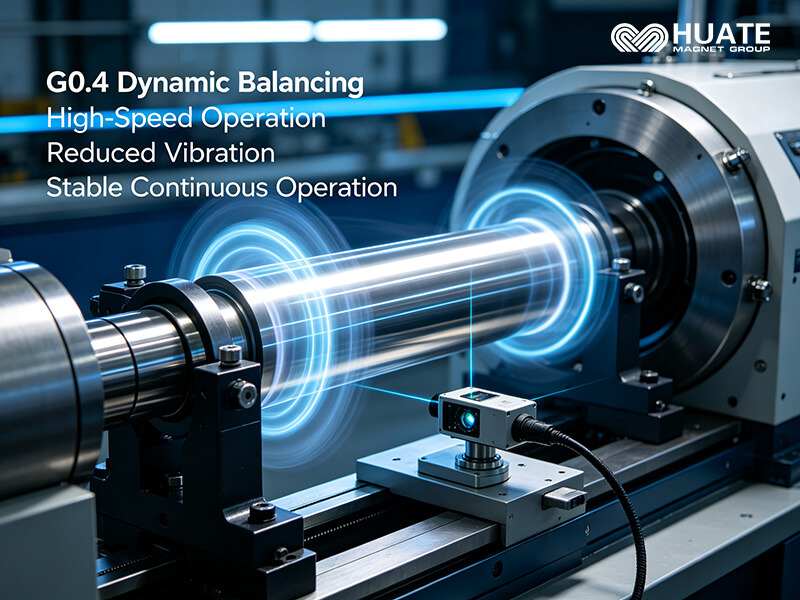
G0.4 Dynamic Balancing for High-Speed Operation
High-speed operation places additional requirements on the mechanical balance of a magnetic rotor.
Huate’s multi-pole high-speed magnetic rotor undergoes G0.4-grade dynamic balancing verification. The balancing design is intended to reduce vibration and noise during high-speed operation while helping protect bearings and transmission components during continuous production.
Stable mechanical operation is particularly important for recycling equipment operating for extended periods, where excessive vibration can affect equipment reliability and maintenance requirements.
Verified Improvement in Eddy Current Separation Efficiency
Prototype testing showed that an eddy current separator equipped with Huate’s multi-pole magnetic rotor achieved a 7.5-percentage-point improvement in separation efficiency compared with the conventional configuration.
The rotor is designed for shredded scrap aluminum with particle sizes ranging from approximately 3–80 mm, making it suitable for integration into continuous aluminum recycling and non-ferrous metal recovery systems.
The development target was a 5–10 percentage-point improvement, and the prototype achieved a 7.5-percentage-point improvement during testing.
Multi-Pole Magnetic Rotor Key Technical Highlights
Key technical specifications of Huate’s high-speed magnetic rotor developed for eddy current separation and aluminum recycling.
| Item | Specification |
|---|---|
| Magnetic Poles | 44 poles |
| Magnetic Arrangement | NN-SS |
| Dynamic Balancing | G0.4 |
| Feed Size | 3–80 mm |
| Tested Efficiency Improvement | +7.5 percentage points |
| Application | Scrap Aluminum Recycling |
Integration into Complete Aluminum Recycling Systems
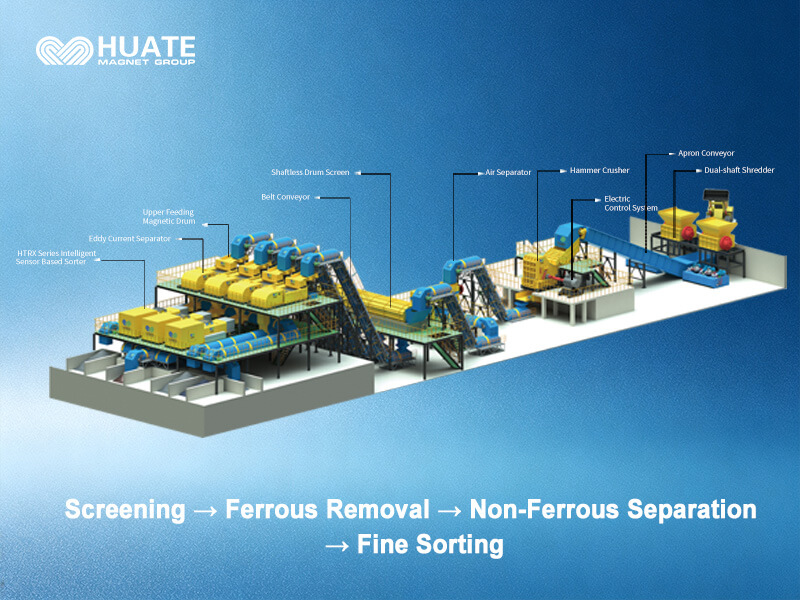
The multi-pole high-speed magnetic rotor is designed as a key component within a complete scrap aluminum sorting system rather than as an isolated separation device.
In a typical recycling line, the eddy current separation stage can work together with:
· Shaftless trommel screens
· Magnetic drums for ferrous metal removal
· XRT intelligent sensor sorting systems
· Eddy current separator
· Centralized control systems
Through coordinated processing, the system can provide multiple stages of material classification, ferrous metal removal, non-ferrous metal separation and further sorting of valuable recyclable materials.
Modern recycling systems commonly combine material screening, magnetic separation and sensor-based sorting to improve the recovery and quality of recyclable materials.
Applications in Non-Ferrous Metal Recycling
The 44-pole magnetic rotor can support eddy current separation applications involving:
Scrap Aluminum Recycling
For shredded scrap aluminum streams, the high-frequency magnetic field is designed to improve the separation of fine conductive particles from non-metallic materials.
Waste Electrical and Electronic Equipment Recycling
Eddy current separation can be integrated into recycling systems where aluminum, copper and other non-ferrous metals need to be recovered from mixed materials.
End-of-Life Vehicle and Scrap Processing
Shredded automotive and industrial scrap may contain aluminum, copper and other non-ferrous metals. Eddy current separator provides a dry method for recovering these conductive materials.
Solid Waste Resource Recovery
Eddy current separators are widely applied in recycling systems for recovering non-ferrous metals from mixed waste streams, including aluminum and copper.
Supporting More Efficient Aluminum Recycling
Improving the recovery of valuable non-ferrous metals is an important part of modern resource recycling. Recycling helps conserve natural resources and reduce the need for extracting and processing virgin raw materials. The U.S. Environmental Protection Agency also identifies resource conservation, energy savings and waste reduction among the major benefits associated with recycling.
By improving the core magnetic rotor technology used in eddy current separator, Huate aims to provide recycling equipment manufacturers and plant operators with more efficient and stable separation solutions.
Huate will continue optimizing magnetic circuit parameters according to different material characteristics and operating conditions, with a focus on applications in aluminum recycling, waste appliance recycling, solid waste resource recovery and other circular-economy industries.
For recycling plants looking to improve non-ferrous metal recovery from shredded materials, Huate can provide customized magnetic separation and sorting solutions based on feed material characteristics, particle size distribution and processing requirements.
Contact Huate to discuss your non-ferrous metal separation requirements.
Post time: Sep-22-2026