
As mining companies continue to face rising energy costs and increasing pressure to improve resource efficiency, comminution has become a critical area for energy-saving and low-carbon transformation.
In mineral processing plants, a large proportion of energy consumption is concentrated in crushing and grinding. This makes the concept of “more crushing and less grinding” increasingly important for improving overall plant efficiency.
Against this background, High Pressure Grinding Rolls (HPGR) technology provides an alternative approach to conventional grinding by using high-pressure material-bed comminution.
Shandong Huate Magnet Technology Co., Ltd. (HUATE) has continuously developed its HPGR technology around four key areas: roll surface technology, transmission structure, intelligent control and process-system integration. Its product portfolio includes HPGM double-drive, PGM single-drive and HCGM split-type high pressure grinding rolls.
What Are High Pressure Grinding Rolls?
High Pressure Grinding Rolls (HPGR) are comminution equipment designed to crush and grind materials through high-pressure compression between two counter-rotating rolls.
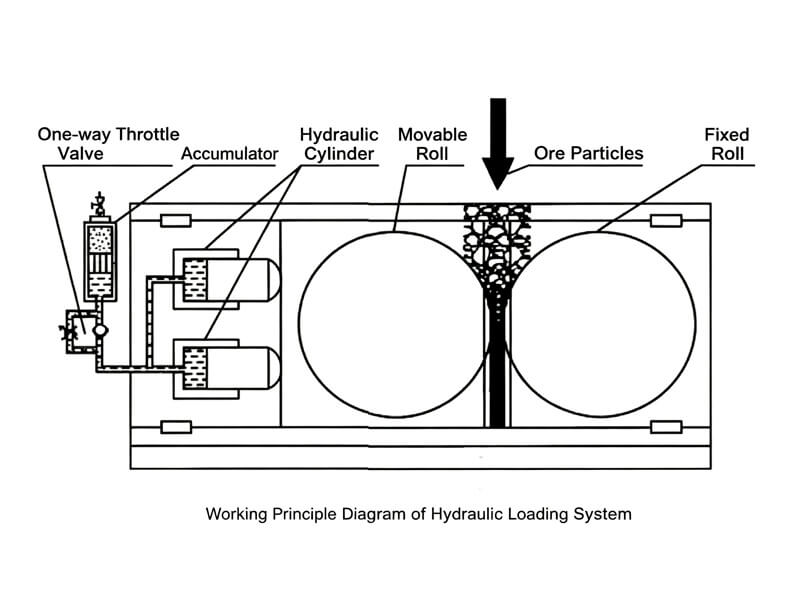
Instead of relying primarily on conventional individual-particle impact and grinding mechanisms, HPGR technology uses high-pressure material-bed comminution. When material enters the roll gap, the pressure between the rolls increases and compresses the particles into a dense material layer.
This high-pressure compression can promote particle breakage and generate microcracks within the processed material, which can facilitate subsequent grinding operations.
Industry research has identified HPGR as an energy-efficient comminution technology and has investigated its potential to reduce energy consumption and carbon emissions in mineral processing circuits.
From Material-Bed Comminution to Intelligent HPGR Technology
The core principle of HPGR is high-pressure material-bed comminution.
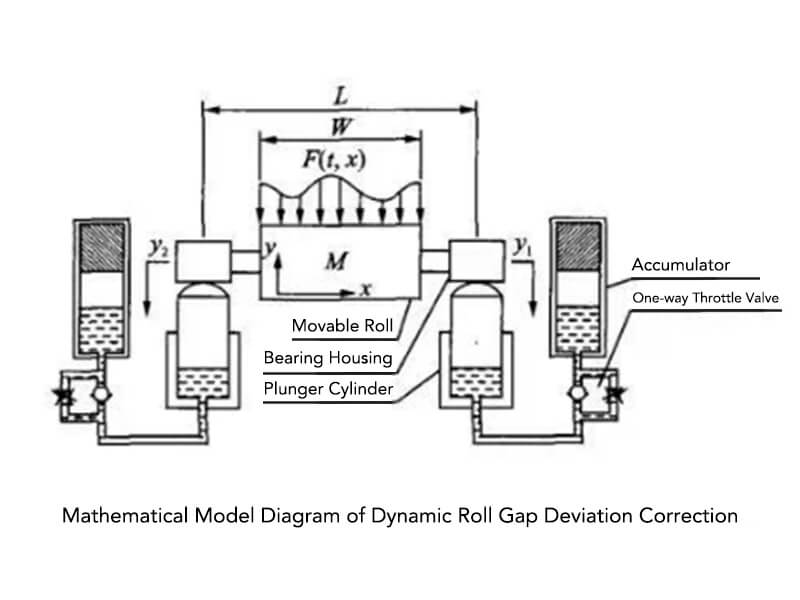
HUATE’s high pressure grinding rolls apply automatically controlled hydraulic pressure to the material between the rolls. As pressure increases, the gaps between particles decrease and the compressed material forms a dense material bed.
The resulting material cake can then be processed through downstream breaking-up, screening or classification operations according to the requirements of the grinding circuit.
This approach allows the HPGR to function not only as an individual grinding machine, but also as an important variable within an integrated mineral processing circuit.
Advanced Roll Surface Technology for Wear Resistance
Roll surface wear is one of the key challenges in HPGR operation, particularly when processing highly abrasive materials.
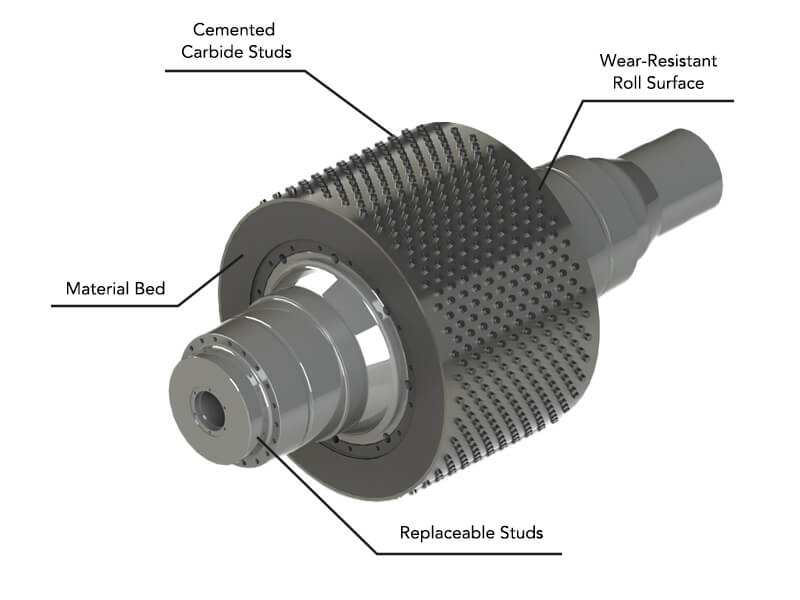
According to HUATE’s technical development approach, the company uses high-quality cemented carbide studs and computer simulation to optimize stud spacing, height and arrangement angle.
The optimized arrangement helps the processed material form a dense material layer between the studs. This material layer helps protect the roll surface while reducing direct contact between the studs and the feed material.
The stud installation process also uses a specialized imported adhesive, while the roll sleeve and main shaft are designed separately. Individual studs can be replaced when required, helping facilitate maintenance.
In a continuous operating test involving titanium ore in Xinjiang, HUATE’s roll surface technology achieved an output fraction below 5 mm of 88.3%, while the proportion of ultrafine material below 200 mesh reached 38%.
These results demonstrate the potential of optimized roll surface design for demanding mineral processing applications.
Intelligent Control for More Efficient HPGR Operation
Modern HPGR systems require more than high-pressure mechanical crushing. Stable operation and process optimization also depend on intelligent control.
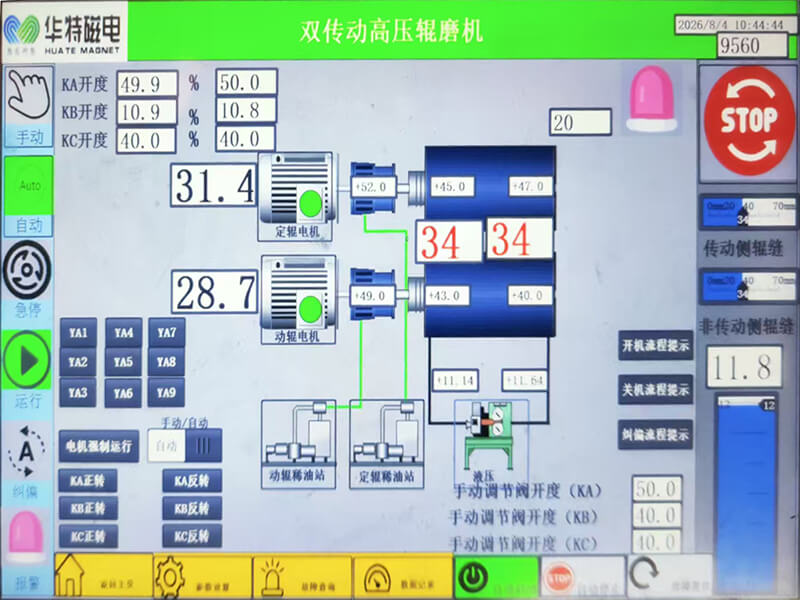
HUATE’s HPGM series is equipped with an independently developed intelligent crushing optimization system based on a Siemens PLC and touchscreen interface.
The system integrates multiple operating parameters, including:
· Roll gap
· Hydraulic pressure
· Roll displacement
· Temperature
· Power
· Bearing condition
Based on real-time operating data, the system can dynamically adjust feed conditions and hydraulic loading.
Key functions include:
· Automatic deviation correction
· Edge material separation
· Constant-pressure closed-loop control
· Automatic foreign-object release
· Centralized lubrication with scheduled and quantitative control
· Intelligent monitoring of main bearing wear
The objective is to maintain stable crushing conditions while reducing the need for manual intervention.
This approach also reflects a broader trend in HPGR technology: combining mechanical efficiency with process control and data-driven optimization. Research into HPGR modeling and control has likewise explored the relationship between operating parameters, energy consumption and particle-size distribution.
Demonstrated Energy-Saving Performance
The technical value of an HPGR system ultimately needs to be evaluated at the process level.
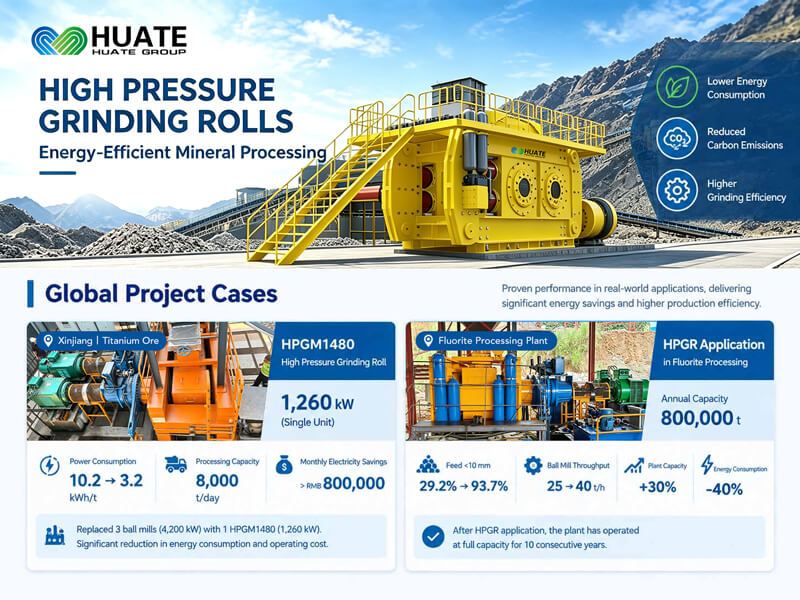
According to HUATE’s supplied project data, an HPGM1480 unit rated at 1,260 kW replaced three ball mills with a combined installed power of 4,200 kW at a titanium processing operation in Xinjiang.
At a processing capacity of 8,000 tonnes per day, the reported electricity consumption decreased from 10.2 kWh/t to 3.2 kWh/t. The project reported monthly electricity cost savings of more than RMB 800,000 for the processing line.
In another fluorite processing plant with an annual capacity of 800,000 tonnes, the proportion of feed below 10 mm entering the grinding stage increased from 29.2% to 93.7%.
Following the application of the HPGR system:
· Ball mill throughput increased from 25 t/h to 40 t/h
· Overall plant capacity increased by approximately 30%
· Specific energy consumption decreased by approximately 40%
· The system has operated at full capacity for ten consecutive years
These project results indicate how HPGR technology can influence not only the grinding machine itself, but also downstream grinding capacity and overall process efficiency.
HPGR as a Process Variable, Not Just a Standalone Machine
One of HUATE’s key engineering concepts is to treat the HPGR as an important upstream variable in the grinding circuit rather than an isolated piece of equipment.
The optimal application of HPGR depends on the material properties, required product size and downstream process configuration.
For titanium ore, HUATE has developed a closed-circuit HPGR and screening process, with the proportion of material below 3 mm increased to more than 75%.
In cement grinding applications, the integration of HPGR with tube mills can increase production by approximately 50%–100% while reducing system grinding energy consumption by approximately 15%–30%.
For steel slag, the HPGR process can reduce material from approximately 30–40 mm to around 8 mm in one pass.
This system-level approach is consistent with industry research showing that HPGR performance depends strongly on circuit configuration and downstream grinding conditions rather than on the HPGR unit alone.
HUATE HPGR Applications and Global Reach
HUATE’s high pressure grinding rolls have been deployed in major mining regions in China, including Xinjiang, Fujian and Shandong.
According to the supplied company data, HUATE HPGR equipment has also been exported in batches to Malaysia, the Philippines and South Africa.
The reported single-machine capacity range is approximately 180–2,300 t/h, while the supplied data indicates comprehensive energy consumption approximately 15%–20% lower than comparable imported equipment and an equipment purchase cost of approximately 50%–70% of imported alternatives.
HUATE’s existing HPGM product range also covers different roll diameters, capacities and power configurations for mineral processing and grinding applications.
Looking Ahead: AI, Larger Equipment and Lifecycle Management
HUATE’s next stage of HPGR development will focus on several technology directions:
· AI-based adaptive and full-process intelligent control
· Advanced wear-resistant stud materials
· Edge-side intelligent electrical control
· Split-type quick-change roll systems
· Quick-disassembly transmission systems
· Full lifecycle equipment management
These developments are intended to further improve equipment maintainability, intelligent operation and large-scale application in mineral processing plants.
Building More Efficient Mineral Processing Systems
The transition toward lower-energy and more efficient mineral processing requires improvements across the entire comminution circuit.
High Pressure Grinding Rolls can serve as an important technology for achieving “more crushing and less grinding” by combining high-pressure material-bed comminution, wear-resistant roll surface technology, intelligent process control and circuit-level optimization.
With continuous development in HPGR equipment and process integration, HUATE is working to provide high-efficiency grinding solutions for mineral processing, cement, steel slag and other demanding applications.
For mining companies evaluating HPGR technology, the appropriate equipment configuration should ultimately be determined according to ore properties, feed size, target product size, throughput requirements and the complete downstream process.
HUATE provides mineral processing equipment and engineering solutions for customers worldwide. Contact HUATE to discuss HPGR applications, equipment selection and mineral processing requirements.
Post time: Sep-20-2026